

Understanding the quality of the water is an important part of wild swimming. Rivers and other natural waters are constantly changing, and rainfall, sewage discharges and other sources of pollution can all affect water quality.
There are a number of resources to help you understand water quality, both in general terms and specifically for the time and place you’d like to swim.
Surfer’s Against Sewage: Live sewage map
Surfers Against Sewage (SAS) have created a Live Sewage Map that brings together live discharge data from more than 18,000 storm overflows across England, Scotland and Wales. It allows you to see where and when sewage discharges are taking place.
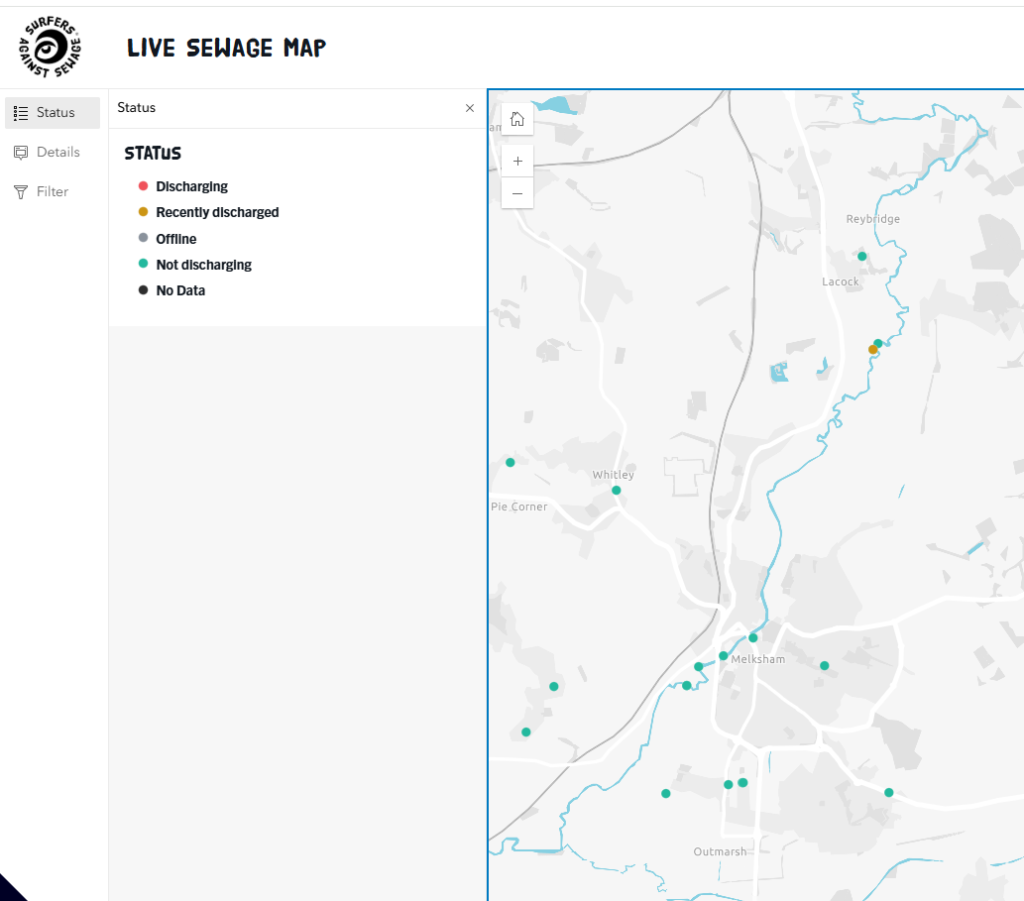
The map uses colour-coded markers to help you understand the latest discharge information: green indicates no recent discharge, orange indicates a recent discharge, and red indicates a live discharge.
It’s a useful starting point when researching a river or coastal swimming location. For alerts and updates to help you plan your swim, you can also visit the Safer Seas & Rivers Service app. Bear in mind that sewage discharge information doesn’t measure bacteria levels at your exact swimming spot or provide a guarantee of water quality. Conditions can vary along a river and change over time.
The Rivers Trust: Sewage in our rivers map
The Rivers Trust provides another helpful resource for understanding sewage pollution in our rivers.
Its interactive river water quality map shows sewage outfalls, including combined sewer overflows (CSOs). These systems are designed to release wastewater when the sewer network is under pressure, often during heavy rainfall, to help prevent sewage backing up into homes and streets. However, discharges can affect river water quality.
The map can help you explore your local stretch of river, locate sewage outfalls and investigate how frequently CSOs have discharged. This provides useful context when learning about the pressures affecting your favourite swimming spots.
For further information on the shocking reality of sewage pollution in English rivers, see this Guardian article on sewage discharges.
You can also read more about wild swimming risks and safety here.
Swimfo with the Environment Agency
If you’re planning to swim at an officially designated bathing water in England, the Environment Agency’s Swimfo bathing water service is a useful place to start. You can search for a designated bathing water by name or location to find its official water quality classification, monitoring results and any available pollution risk forecasts.
For an overview of multiple bathing water sites or to download water quality data, visit the Environment Agency’s bathing water data page.
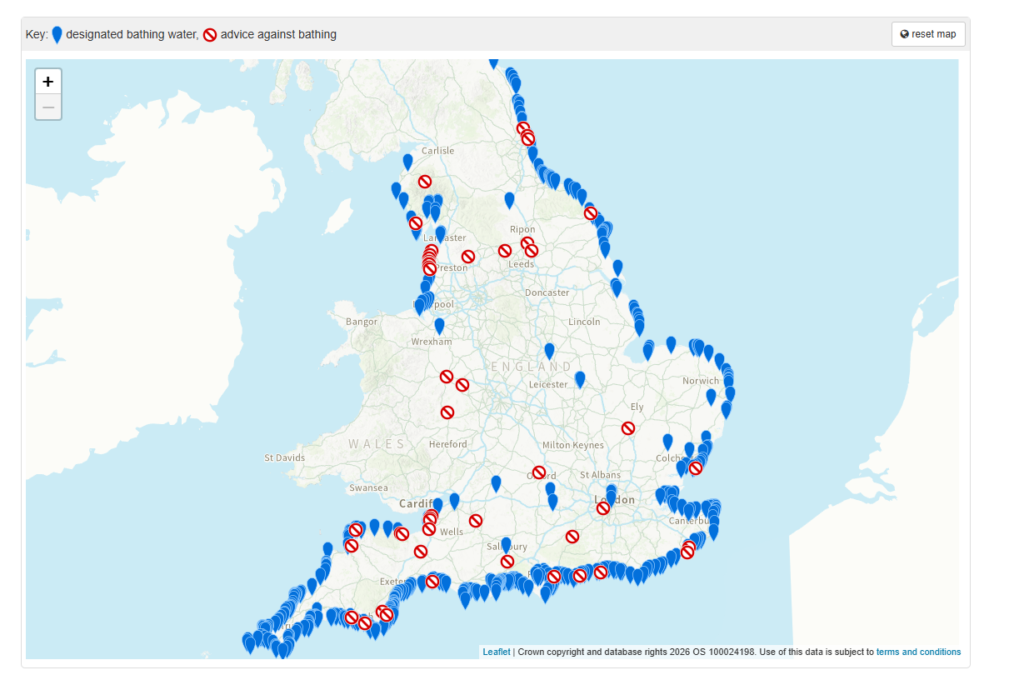
The Environment Agency assesses water quality at designated bathing water sites in England by taking samples during the bathing season, which runs from May to September. At some locations, daily pollution risk forecasts are also available to help identify when conditions may be temporarily less suitable for swimming.
Each designated site receives an annual classification of Excellent, Good, Sufficient or Poor, based on bacterial measurements collected over a period of up to four years. These ratings provide a useful indication of longer-term water quality, but they don’t guarantee conditions on any particular day, so it’s worth checking the latest available information before you swim.
If you’re swimming elsewhere in the UK, you can find official bathing water information through the relevant national agency: Scotland (SEPA), Wales (Natural Resources Wales) or Northern Ireland (DAERA).
Checking Historical River Water Quality with the Environment Agency
The Environment Agency’s Water Quality Explorer lets you explore water quality measurements collected at monitoring sites across England. It contains data dating back to 2000 and covers a wide range of measurements, from nutrients and general water chemistry to metals and other pollutants. Find more information here: official guidance.
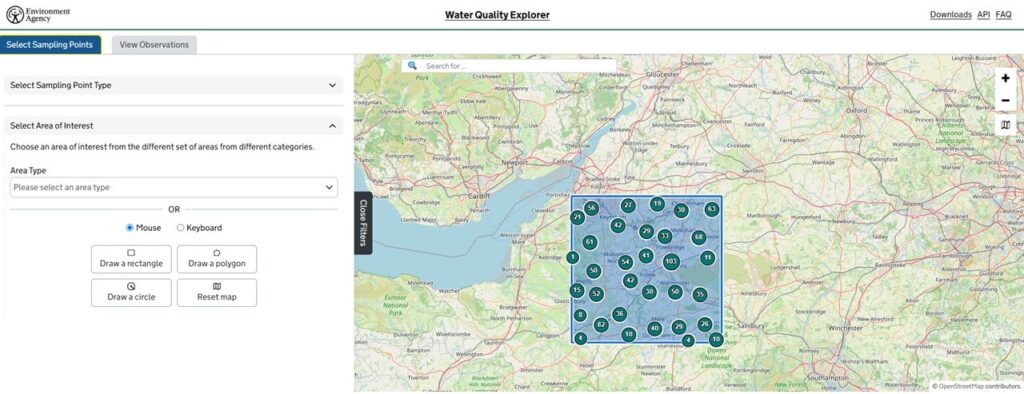
To explore your local river, open the map and search for your area by selecting a geographical area or drawing an area on the map.
You can then explore the available observations, including sampling locations, sample types, the parameters measured and the results recorded. Depending on the data available, you can also download results for further investigation.
When looking at the results, check the sampling location, date and type of measurement carefully. A sample taken upstream, downstream or in a tributary may not represent the stretch of river where you plan to swim.
An important point for wild swimmers: the Water Quality Explorer is designed for environmental monitoring, not to tell you whether a river is safe to swim in today. Sampling may be infrequent, and the available measurements may not include bacteria such as E. coli or intestinal enterococci. Use the data to learn about the river’s wider environmental health, rather than as a real-time swimming safety indicator.
For more information, read the Environment Agency’s guidance on the Water Quality Explorer and wild swimming.
Water Quality and Ecology
Our rivers and lakes are cleaner today than in the 1950s and 1960s when industrial and agricultural pollution almost succeeded in killing our rivers. In the 1960s but the success of the 1974 Control of Pollution Act and subsequent European legislation has been remarkable.
Most people’s first concern is usually sewage but with the new European Water Framework Directive in place all effluent now undergoes at least two treatments before entering a river and, increasingly, a third to make it completely sterile and pure. Any bacteria that do remain are quickly killed by the sun’s UV rays, or eaten up in the micro-foodchain of the river so, the further downstream of the treatment works you are, the cleaner the water will become. Treatment sites are indicated on OS maps as a little cluster of four or six circles by rivers near towns.
Health risks
Blue–green algae
In lowland lake swimming, after warm, wet weather, usually in late summer, Blue-green algae can multiply and a powdery, green scum (the blooms) can collect on the downwind side of a lake. It’s obvious and unpleasant and can give you a skin rash or irritate your eyes if you bathe in it, and make you sick if you swallow it. Find a part of the lake without blooms or go somewhere else.
‘Swimmer’s itch’ (cercarial dermatitis)
Swimmer’s itch can be caught from contact with little snails that live on the reeds around marshy lakes and stagnant ponds. It creates a temporary but sometimes intense itching sensation that can last for up to two days. It’s not common, and requires no treatment, but it’s best to avoid wallowing in the bogs when outdoor swimming!
Weil’s disease
In urban areas sewers and storm drains may harbour colonies of rats whose urine may carry the bacterial infection Leptospirosis. Never swim in urban rivers, particularly canals, and be particularly cautious after heavy rains. None of the locations in this book carry any significant risk but if you are concerned about water quality cover any open wound with a waterproof plaster and keep your head (eyes, nose and throat) out of the water as much as possible. If you get flu or jaundice-like symptoms three to fourteen days after swimming in high risk water ask your doctor for a Leptospirosis test. It is simply treated with antibiotics but if left it can develop into the more serious Weil’s disease, which has been known to kill.

Wild Swimming Britain – 1000 hidden dips in the rivers, lakes and waterfalls of Scotland, England & Wales. Celebrating the best of British wild swimming
Many of people don’t know about swimming water quality but after reading of this blog they all of known as better. Now people will easily to select or choose that which swimming school is suitable for swim regarding swim water. Thanks for sharing. Now i am easily to search swim school for my younger baby which is suitable for her swim learning
Thanks for this good sharing I love all ideas and apply these within proper time. We know that funky trunks water quality has much importance. These all ingredients are useful for water best quality. So before jumping in water first check the quality otherwise takes help from swimming schools.